How to Use Duolingo Practice Test for DET Prep (2026 Complete Guide)
If you want to genuinely raise your DET score, the answer isn't "do more practice tests." It's making every single practice test count.
This guide gives you an actionable system: use the official practice tools to establish your baseline, drill specific skills to fix weak spots, then bring in high-quality third-party mock exams for final-stage diagnosis. We've incorporated expert insights throughout and included a ready-to-use study workflow you can start today.
Note: DET question types, scoring, and platform features are updated periodically. Where this article references dynamic information, we've added verification prompts. Always confirm details on the official Duolingo English Test website.
The Bottom Line: What's the Most Effective Way to Use Duolingo Practice Tests?
The highest-impact study cycle is:
Baseline Test → Error Analysis → Targeted Practice → Periodic Re-test
- Take the official Full-length Practice Test to establish your baseline — note your score range and how the test flows.
- Use the official Practice Skills Question Sets to address weaknesses by question type or skill area.
- When you need more questions, supplement with high-quality third-party practice materials.
- Re-take a full practice test every 7–10 days to track changes in your score range and weak areas.
If your current approach is "find random questions → check the score → hope for the best," switching to this cycle will immediately sharpen the way you study.
1. Official Duolingo Practice Test (with Expert Insights)
The official practice tools fall into two categories:
- 🔗 Official Practice portal (login required)
- 🔗 Official Full-length Practice (login required)
Once logged in, the Full-length Practice page states: "Get your unofficial estimated score in just 45 minutes — for free." The Skills page lets you filter by question type or by skill (Reading, Listening, Speaking, Writing).
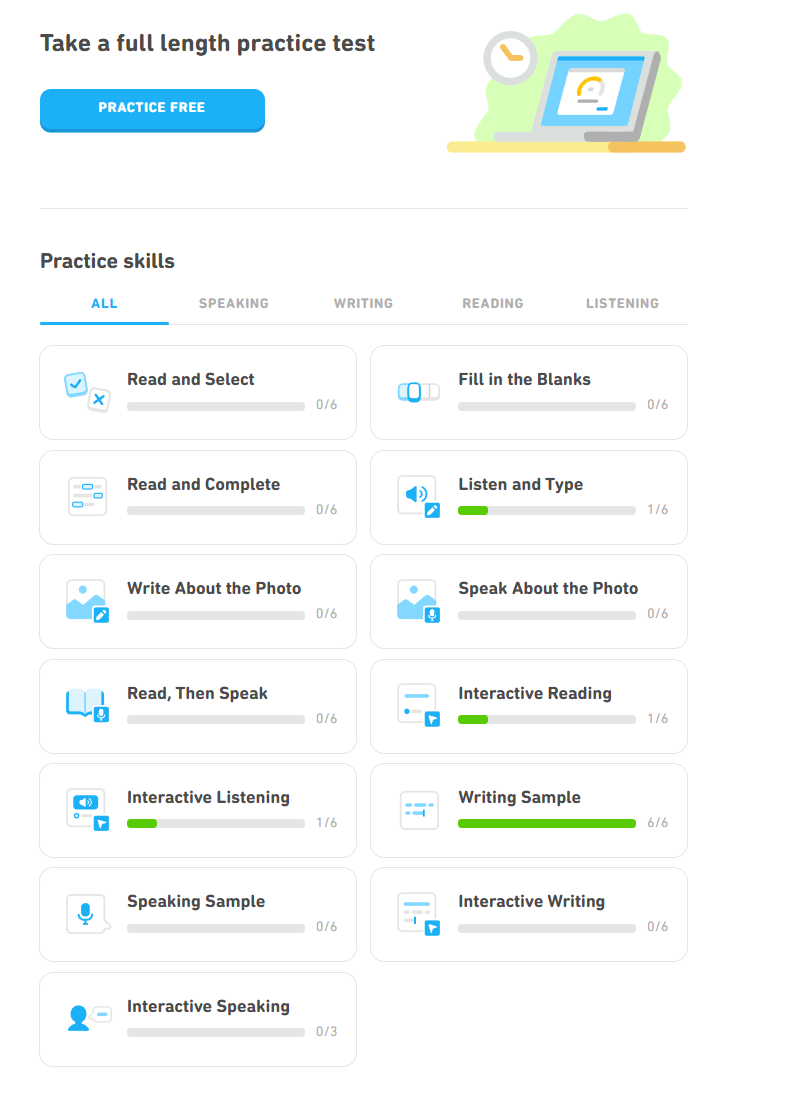
Full-length Duolingo Practice Test
What It Does
- Lets you experience the question types and general sequence you'll encounter on test day.
- Provides an unofficial estimated score range useful for tracking your progress over time.
Key Differences You Must Know (Expert View)
Although the official page calls it "full-length," the number of questions is typically fewer than the actual certified test. Based on expert analysis, the most common differences include:
| Question Type | Certified Test (per Official Guide) | Practice Test |
|---|---|---|
| Interactive Reading | Typically 2 sets | Usually 1 set |
| Interactive Listening | Typically 2 sets | Usually 1 set |
| Write about the Photo | Typically 3 consecutive prompts | Usually 1 prompt |
This is why many test-takers feel the practice test goes by much faster than the real exam — the question volume is noticeably lighter.
Verification tip: Question counts and distributions may change. Cross-check with the official preparation page and the current Official Guide before your test date.
How to Interpret Your Score (Expert View)
The Full-length Practice Test gives you a score range, not a certified score. To get a more stable estimate:
- Take the test approximately 3 times.
- Record the range each time.
- Track the trend of the midpoint values — use that as your working benchmark.
When to Use the Full-length Practice Test
- Early-stage prep: Get familiar with DET question types and test flow while establishing your initial score range.
- Progress check-ins: Re-test after a study period to see if your range has shifted upward.
- Institutional or interview settings: Useful for a quick on-the-spot English proficiency assessment.
- Budget-conscious prep: A free mock exam you can take repeatedly.
Practice Skills Question Sets
This feature breaks the test into individual question types and lets you practice by type or by skill — no need to sit through a full test every time.
Why It's Valuable
- The question pool may not be large, but the questions tend to be highly representative of the real test.
- Ideal for test-takers who have limited time but still want to improve their scores.
When to Use It
- Getting comfortable with a specific question type: Practice just one type to learn the interface, steps, and response mechanics.
- Targeted skill building: If your speaking or writing needs urgent improvement, go straight to those tasks for maximum efficiency.
2. Third-Party Duolingo Practice Tests (with Expert Insights)
The expert view is clear on this point: third-party quality varies significantly — always vet before you commit.
How to Evaluate a Platform
Prioritize platforms that demonstrate:
- Higher-tier partnership credentials (e.g., GPN advanced-level partners)
- Consistent question research and content updates
- Market examples cited by experts include: DETPractice, Arno, and DET Ready
Verification tip: Partnership tiers and credentials can change. Always confirm with the platform's current public disclosures.
Free Third-Party Duolingo Practice Tests
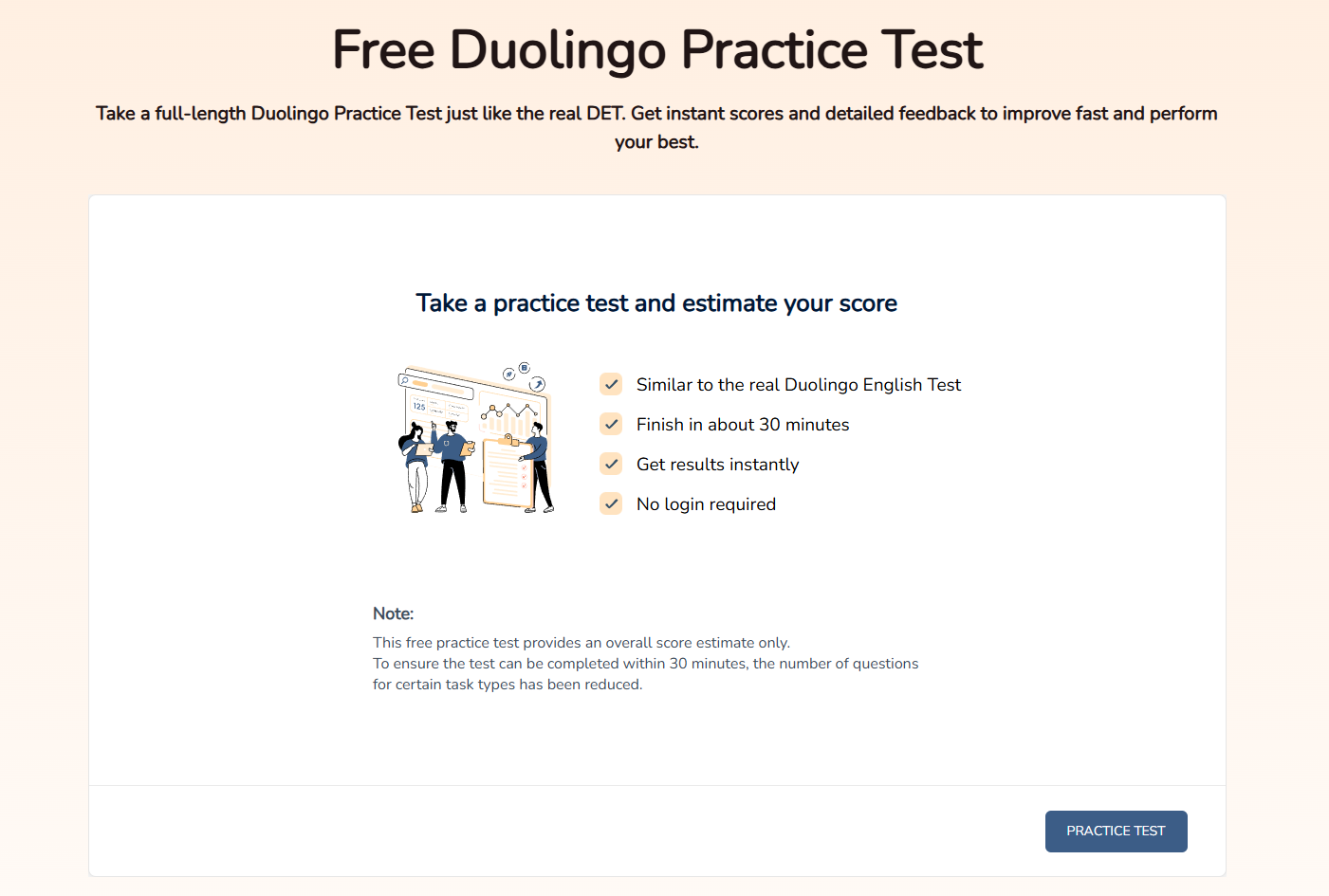
Example: DETPractice Free Duolingo Practice Test
Common features of free third-party tests:
- Can typically be completed in about 30 minutes.
- Provide a quick score range upon completion.
- Some platforms require no registration, making them easy to access.
When to Use Them
- Quick score estimation: No complex sign-up process — just start the test and get your current level range.
- Fresh questions after exhausting official materials: When the official questions start feeling repetitive, switching to a new platform keeps your practice fresh.
Paid Full-length Third-Party Practice Tests
The expert view emphasizes that high-quality paid full-length tests focus on 1:1 scenario replication — matching the real test in question count, time limits, and flow — while delivering more granular diagnostics.
Typical Value-Added Outputs
- Full score report: Overall score plus sub-scores across multiple dimensions (e.g., 8 sub-scores, depending on the platform).
- Complete response history: Review every single answer for thorough post-test analysis.
- Speaking and writing feedback: Pinpoint your weaknesses with targeted correction notes.
When to Use Them
- When you need a more accurate performance estimate: A detailed report tells you more about your ceiling than a score range alone.
- When you need to identify structural weaknesses: Spot imbalances like "strong reading, weak speaking" that hold your total score back.
- When you want to maximize study efficiency: Train based on diagnosed weaknesses instead of grinding random questions.
3. How to Combine Official and Third-Party Resources (Maximum Impact, Minimum Cost)
Here's a ready-to-use four-step workflow.
Step 1: Establish Your Baseline
- Take the official Full-length Practice Test once.
- Record your score range, pacing, and which question types tripped you up.
Step 2: Build an Error Analysis Sheet
Three columns are all you need:
| Where You Lost Points | Why | Corrective Action |
|---|---|---|
| Speaking — ran out of time | Disorganized structure, couldn't finish | Practice with an "Intro → Body → Wrap-up" template on a timer |
| Writing — off-topic response | Failed to identify key terms in the prompt | List 3 keywords before writing |
| Listening — missed details | Focused on gist only, dropped specific data points | Do dictation + reproduction drills to sharpen detail capture |
It doesn't need to be fancy. The point is to make your recurring mistakes visible so you know exactly what to fix.
Step 3: Targeted Practice (3–5 Days)
- Go to the official Skills practice page and drill your weak question types.
- If you need more questions, supplement with high-quality third-party practice sets.
Step 4: Periodic Re-test (Every 7–10 Days)
- Take a full mock exam.
- Compare your score range midpoint, sub-score changes, and whether the same errors are recurring.
- Use the results to enter your next cycle.
4. Common Mistakes (The Real Reasons Scores Plateau)
- Grinding without reviewing. Doing lots of practice tests means nothing if you never analyze what went wrong.
- Treating one practice score as your final score. Score ranges naturally fluctuate — one bad result doesn't define your ability.
- Neglecting speaking and writing. These carry significant weight. Avoiding them keeps your total score stuck.
- Practicing in a too-relaxed environment. If you never simulate test-day pressure, nerves will cost you points on the real exam.
- Choosing platforms based on marketing alone. Always check feedback quality and update frequency, not just claims.
FAQ
Is the official Practice Test score accurate?
It's best used for trend tracking, not as a definitive score. Look at how your range shifts over 2–3 attempts rather than fixating on a single result.
Can I prepare effectively with only free resources?
Absolutely. Start by fully utilizing the official tools, then add free third-party questions as needed. Consider paid options only if you need more detailed diagnostics during your final push.
How often should I take a full practice test?
Every 7–10 days is a good cadence. Spend the time in between fixing the root causes of your errors — that's what actually moves the needle.
How do I choose a third-party platform?
Look for: update frequency, depth of feedback, transparent disclosure that "estimated scores are not official certifications," and verifiable partnership credentials.
Final Thought: Turn Your Practice Tests into a Score-Building System
The number that matters isn't "how many tests I did today." It's "how many recurring mistakes I eliminated this cycle."
Official Baseline → Skills-Based Targeted Practice → Third-Party Supplementation & Diagnosis → Periodic Re-test
As long as each cycle reduces your repeat errors, your DET score will steadily climb.
Found this guide helpful? Explore more DET prep strategies on the DETPractice Blog and try our free Duolingo Practice Test to start your baseline today.