Read, Then Speak

Read a Prompt and Speak Your Response (90 Sec)

For the Read, Then Speak task, you will be given a written prompt asking about a personal experience or opinion. You have 20 seconds to read it, followed by 90 seconds to speak your answer. Your ability to comprehend the prompt and speak fluently is critically assessed here.

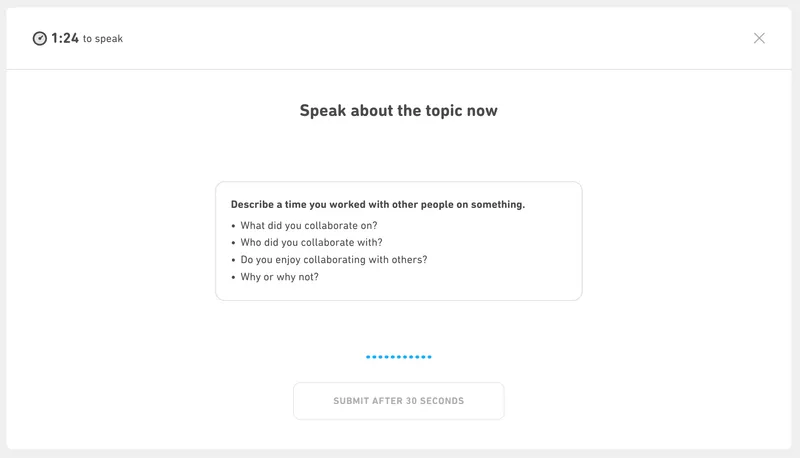
Test Screen Guide

Familiarize yourself with the interface so you don't waste precious preparation time on test day.

UI Screenshot
+
+
+

How It's Scored

Your spoken response directly impacts these three primary subscores:

Speaking

Measures your ability to articulate your thoughts clearly, evaluating your pronunciation and grammatical accuracy as you orally respond to the written prompt.

Conversation

Evaluates your speaking fluency, natural pacing, and ability to smoothly transition between ideas in real-time without relying on a pre-written script.

Production

Assesses your ability to spontaneously generate descriptive vocabulary, idioms, and complex sentence structures directly from a set of bullet points.

Deep Dive: Read, Then Speak

The 20-Second Preparation Window

Before the camera and microphone start recording, you have exactly 20 seconds to read the prompt. Use this time to mentally map out a chronological or logical structure. Remember: The Duolingo English Test strictly prohibits the use of pens, paper, or any physical note-taking. Because you cannot write anything down, let your eyes quickly scan the bullet points - they act as a built-in outline for your speech. Decide on your main argument or the core story you want to tell immediately.

Pacing and Natural Fluency

A common trap is attempting to speak as fast as possible to squeeze in more words. The grading AI does not reward speed; it rewards grammatical control, varied sentence structures, and natural rhythm. It is perfectly acceptable to take brief, natural pauses to gather your thoughts, just as you would in a real conversation. Attempting to force highly complex vocabulary words unnaturally will disrupt your fluency and lower your score.

Addressing the Bullet Points

The prompt usually provides a main question followed by several bulleted sub-questions. While you should try to cover all of them to ensure a comprehensive answer, do not panic if you miss one. The AI evaluates the quality and relevance of your spoken English, not whether you strictly adhered to every single bullet point.

Practice Strategies

  • 1

    The 'Bullet Point Checklist'

    Mentally assign 15-20 seconds of speaking time to each bullet point on the screen. This guarantees you will have enough content to fill the 90 seconds without awkward silences.

  • 2

    Use Transitional Phrases

    Score high in Coherence by linking your thoughts together. Instead of abruptly jumping between bullet points, use phrases like 'Furthermore,' 'On the other hand,' or 'As for the second point...'.

  • 3

    Tell a Personal Story

    If the prompt asks for an opinion or experience, grounding your answer in a personal anecdote makes it much easier to speak fluently and continuously, as memories flow more naturally than abstract concepts.

DO

  • Look at the camera occasionally to simulate a natural conversation.
  • Use the prompt's bullet points as a structural roadmap for your response.
  • Speak at a steady, intelligible volume and pace.

DON'T

  • Do not read the prompt out loud during your speaking time; it wastes precious seconds.
  • Do not panic if you stumble over a word; smoothly correct yourself and keep going.
  • Do not stare blankly at the countdown timer, as it will cause unnecessary anxiety.

Common Queries about the Read Then Speak Task

Down Arrow

Do I lose points if I do not speak for the full 90 seconds?

Down Arrow

What if I forget to answer one of the bullet points?

Down Arrow

Does the prompt disappear once the 20-second prep time is over?

Down Arrow

Can I take notes during the 20-second preparation?

Down Arrow

Is it bad if I pause to think?

Down Arrow

What happens if I just read the prompt text out loud?