Interactive Writing

A Connected Two-Part Task (5 Mins + 3 Mins)

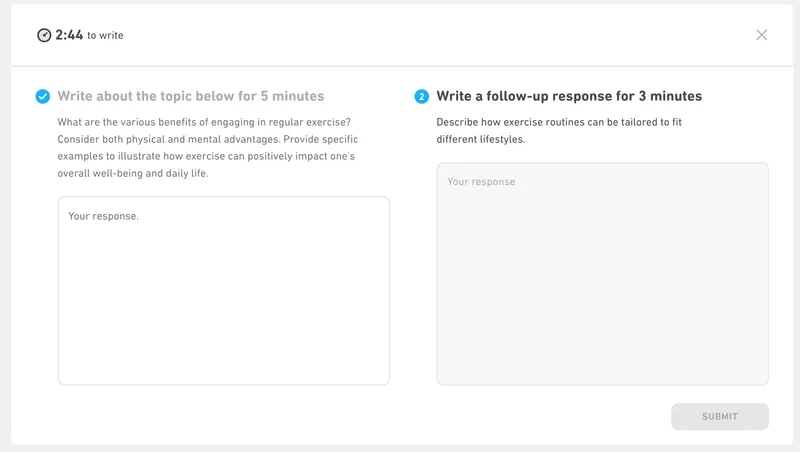
Interactive Writing is unique because it consists of two connected parts. In Part 1, you have 5 minutes to write about a given topic. In Part 2, you have 3 minutes to answer a follow-up question directly related to the same topic. Both parts are evaluated together to provide a comprehensive assessment of your writing abilities.

Test Screen Guide

Familiarize yourself with the interface of the primary writing window.

UI Screenshot
+
+
+
+

How It's Scored

Both parts of your written response are evaluated together to directly impact these subscores:

Writing

The most heavily impacted subscore. Measures your ability to construct coherent paragraphs, use correct grammar, and accurately spell words over an extended period.

Literacy

Evaluates your ability to accurately read and comprehend both the initial prompt and the nuanced follow-up question so your responses remain highly relevant.

Production

Assesses your ability to intentionally use a wide range of vocabulary, advanced idioms, and complex sentence structures in a written format.

Deep Dive: The Two-Part Transition

The Follow-Up Question Trap

The most common mistake candidates make in Interactive Writing is repeating themselves in Part 2. Remember, Part 2 is a follow-up. If Part 1 asks you to describe your favorite hobby, Part 2 might ask: 'How has this hobby changed the way you view the world?' If you spend Part 2 just re-explaining the hobby, the grading AI will penalize you for not answering the specific new question.

Managing the 5-Minute Window

In Part 1, you have an initial 30 seconds of pure preparation time where you should not start typing immediately. Use this time to mentally map out a 3-paragraph structure (Introduction, Body, Conclusion). Once you start typing, aim to finish your thoughts by the 4-minute mark, reserving the final 60 seconds strictly for proofreading grammar and punctuation.

Aiming for Complexity

Because you have a generous amount of time compared to other tasks, the AI expects high-level Production. Simple 'Subject-Verb-Object' sentences will not yield a high score here. You must actively demonstrate your ability to use complex subordinating clauses (e.g., 'Although I initially struggled, I eventually realized...'), varied vocabulary, and flawless spelling.

Practice Strategies

  • 1

    The 3-Paragraph Minimum

    For Part 1, forcefully divide your thoughts into at least three distinct visual paragraphs (Intro, Body, Conclusion). The AI interprets paragraphing as a sign of advanced organizational skills.

  • 2

    The 'Elevate' Strategy

    During your 60-second proofreading phase, don't just look for typos. Look for simple words like 'good' or 'bad' and intentionally elevate them to 'beneficial' or 'detrimental'.

  • 3

    Anticipate Part 2

    While writing Part 1, don't exhaust every single facet of the topic. Leave some room for expansion. Part 2 will inevitably ask you to elaborate, provide an alternative viewpoint, or predict a future outcome.

DO

  • Treat Part 1 and Part 2 as two chapters of the same book; they must connect logically.
  • Write as much as you comfortably can while maintaining high grammatical accuracy.
  • Always save the last 45-60 seconds exclusively for proofreading.

DON'T

  • Do not copy and paste sentences from Part 1 into Part 2.
  • Do not ignore the specific follow-up question in Part 2 just to dump more pre-memorized facts.
  • Do not use overly casual language, slang, or text-message abbreviations (like 'u' instead of 'you').

Interactive Writing Question Type FAQ

Down Arrow

Do I get to see the Part 2 question while I am working on Part 1?

Down Arrow

What happens if I run out of time in Part 1?

Down Arrow

Can I go back and edit Part 1 after seeing the Part 2 question?

Down Arrow

Since Part 2 continues the same topic, is it bad if I reuse vocabulary from Part 1?

Down Arrow

Will I lose points if I don't write a very long essay?

Down Arrow

What is a good word count target for the 5-minute Part 1?