Write About the Photo

Describe the Scene in Detailed Text (1 Min)

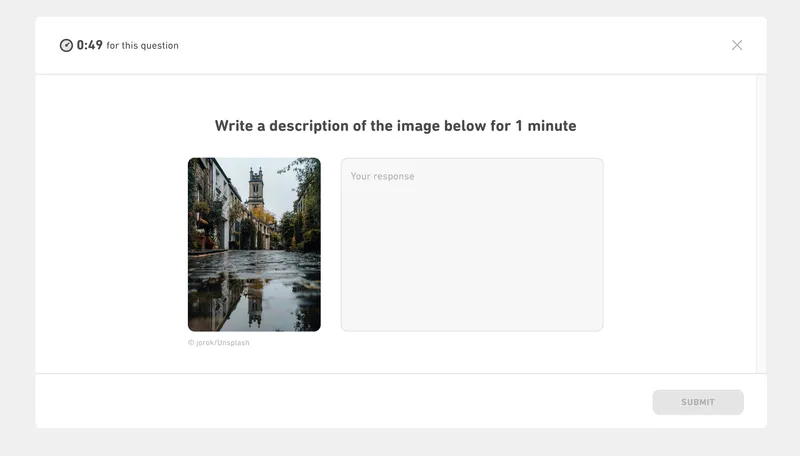
In the Write About the Photo task, you will see an image and have exactly 1 minute to type a description of it. Doing more than simply labeling what you see is essential. This task appears 3 times during the test and is a key measure of your real-time written production skills.

Test Screen Guide

Familiarize yourself with the interface to maximize your 60-second typing window.

UI Screenshot
+
+
+
+

How It's Scored

Your written description directly impacts these three primary subscores:

Writing

Evaluates your spelling, grammatical accuracy, and ability to construct complex sentence structures from scratch.

Literacy

Measures your fundamental ability to read the test interface and translate visual information accurately into written text.

Production

Assesses your ability to generate descriptive vocabulary (adjectives and adverbs) under a strict 60-second time pressure.

Deep Dive: Write About the Photo

The 60-Second Challenge

Unlike Speak About the Photo where you can continuously generate ideas aloud, typing requires both thought and mechanical speed. One minute vanishes incredibly quickly. You do not have time to write a miniature essay or ponder complex grammatical structures. Your goal is simply to produce 2 to 3 high-quality, descriptive sentences that capture the essence of the image.

Going Beyond 'Labeling'

The single biggest mistake candidates make is writing lists or basic labels (e.g., 'I see a man. He is walking. There is a dog.'). This demonstrates very low-level English proficiency. To score well, you must synthesize these elements into complex sentences. Instead of labeling the man and the dog separately, combine them using descriptive adjectives and prepositional phrases: 'A warmly dressed man is walking his energetic dog through a snow-covered park.'

The Power of 'Maybe' (Speculation)

If the photo is simple and you quickly run out of literal things to describe, transition to speculation. Use words like perhaps, likely, appears to be, or might be to guess why the subjects are doing what they are doing. ('The man is walking quickly, perhaps because he is late for work, or maybe he is just trying to stay warm in the freezing weather.') This proves you can use language to infer meaning, a highly valued skill on the DET.

Practice Strategies

  • 1

    The 'Who, What, Where' Approach

    Structure your first sentence to answer these three questions immediately. E.g., 'A young woman (who) is reading a book (what) in a crowded cafe (where).'

  • 2

    Inject Adjectives and Adverbs

    Elevate your vocabulary by describing the nouns and verbs. Is the woman just 'reading,' or is she 'intently reading'? Is the cafe 'crowded' or 'bustling'? These small additions boost your Production score.

  • 3

    Check Your Grammar

    Because you are rushing, it is easy to forget simple grammar rules like subject-verb agreement or articles (a/an/the). Save the last 10 seconds exclusively for proofreading.

DO

  • Write in complete, grammatically correct sentences.
  • Use descriptive vocabulary (adjectives and adverbs) to paint a picture with words.
  • Describe the atmosphere or mood of the photo, not just the physical objects.

DON'T

  • Do not write a bulleted list of words or sentence fragments.
  • Do not start your description with generic filler phrases like 'In this picture I can see...'.
  • Do not use highly complex vocabulary if you are unsure how to spell it correctly.

Common Questions on the Write About the Photo Task

Down Arrow

Is there a minimum or maximum word count?

Down Arrow

What if I misspell a word?

Down Arrow

Should I write in the 1st person or 3rd person?

Down Arrow

What if I don't know the exact vocabulary word for an object in the picture?

Down Arrow

What if I don't finish my sentence before the timer runs out?

Down Arrow

Does punctuation matter?